Detention Time Calculation for Wastewater Operators
Master the detention time calculation with worked examples, unit conversions, and exam tips. HRT formula made simple for your certification exam.
What Is Detention Time and How Do You Calculate It?
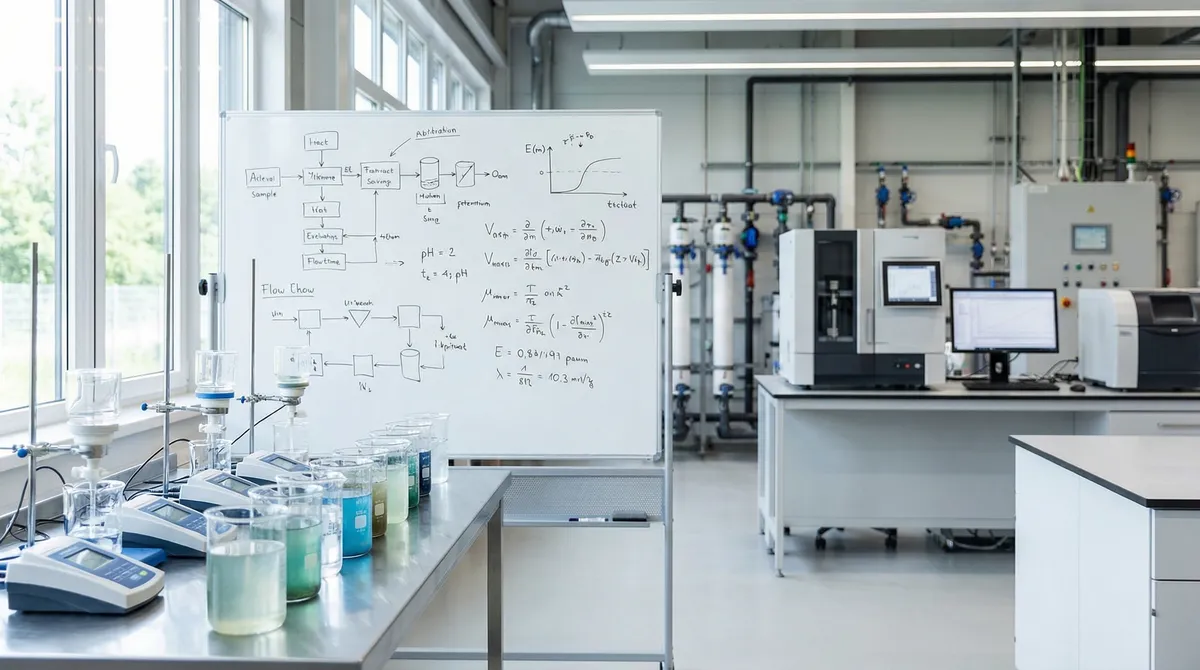
The detention time calculation divides the volume of a tank by the flow rate to find the average theoretical time a drop of water stays in that tank or basin. Also called hydraulic retention time (HRT), this value tells you how long water is held in a treatment unit. In practice, actual residence times vary due to short-circuiting and dead zones, but for exam purposes the hydraulic retention time formula is straightforward.
Detention Time = Volume of Tank / Flow Rate
That's it. Volume divided by flow. The concept is dead simple. What makes this formula tricky on exams isn't the math - it's getting your units to play nice before you plug and chug.
Why Does Detention Time Matter in Wastewater Treatment?
Every major process in your plant depends on time. Chlorine needs contact time to kill pathogens. Activated sludge bugs need time to eat BOD. Clarifiers need time for solids to settle. If flow spikes and detention time drops, your treatment suffers.
Here's where it shows up:
- Primary clarifiers - Typical detention time of 1.5 to 2.5 hours. Too short and solids carry over to secondary treatment.
- Aeration basins - Typically 4 to 8 hours for conventional activated sludge. Cut this short and your bugs don't have enough time to do their job.
- Chlorine contact chambers - Usually 15 to 30 minutes at peak flow. Note that effective contact time depends on the CT value (concentration x time) and the tank's baffling factor, which reduces effective detention time below the theoretical value. Falling below your required disinfection contact time can lead to permit violations, depending on your specific permit language and disinfection requirements.
- Secondary clarifiers - Typically 2 to 4 hours. Reduced detention time means higher effluent TSS.
When your superintendent asks "what happens if we take that clarifier offline for maintenance?" - you're doing a detention time calculation to figure out if the remaining units can handle the load.
How Do You Handle Unit Conversions for HRT Calculations?
Here's where operators get tripped up. The formula is simple division, but your volume might be in gallons, cubic feet, or liters, and your flow rate might be in gallons per day, gallons per minute, MGD, or cubic feet per second. Your answer needs to come out in hours or minutes.
If your units don't match, your answer is garbage.
The two most common setups on exams:
Setup 1: Volume in gallons, flow in gallons per day
Detention Time (days) = Volume (gallons) / Flow (gallons per day)
Then multiply by 24 to convert to hours.
Setup 2: Volume in cubic feet, flow in cubic feet per something
You'll often need to convert gallons to cubic feet or vice versa. The key conversion factor: 1 cubic foot = 7.48 gallons. Burn that into your brain.
Key Takeaway
The detention time calculation formula is Detention Time = Volume / Flow. The most critical skill is matching your volume and flow units before dividing. Use 7.48 gallons per cubic foot to convert between cubic feet and gallons, and multiply by 24 to convert days to hours. Most basins are expressed in hours; contact chambers are expressed in minutes.
Worked Example 1: Gallons and MGD
This is one of the most common ways you'll see the detention time calculation on exams.
Worked Example
Given: A clarifier holds 350,000 gallons. The plant flow is 2.0 MGD. What's the detention time in hours?
Step 1: Convert MGD to gallons per day 2.0 MGD = 2,000,000 gallons/day
Step 2: Plug into the formula Detention Time = 350,000 gallons / 2,000,000 gallons/day
Step 3: Divide 350,000 / 2,000,000 = 0.175 days
Step 4: Convert days to hours 0.175 days x 24 hours/day = 4.2 hours
Answer: Detention time = 4.2 hours
Notice how the gallons cancel out and you're left with days. Then you convert to hours because nobody thinks in fractions of a day.
Worked Example 2: Cubic Feet to Gallons
Sometimes the exam gives you tank dimensions instead of a volume in gallons. That means you need to calculate the volume in cubic feet first, then convert.
Worked Example
Given: A rectangular sedimentation basin is 60 ft long, 20 ft wide, and 10 ft deep. Flow is 1.5 MGD. What's the detention time in hours?
Step 1: Calculate volume in cubic feet Volume = Length x Width x Depth Volume = 60 ft x 20 ft x 10 ft = 12,000 ft³
Step 2: Convert cubic feet to gallons 12,000 ft³ x 7.48 gal/ft³ = 89,760 gallons
Step 3: Convert MGD to gallons per day 1.5 MGD = 1,500,000 gallons/day
Step 4: Plug into the formula Detention Time = 89,760 gallons / 1,500,000 gallons/day
Step 5: Divide 89,760 / 1,500,000 = 0.05984 days
Step 6: Convert to hours 0.05984 days x 24 hours/day = 1.44 hours
Answer: Detention time = 1.44 hours (about 1 hour and 26 minutes)
Worked Example 3: Circular Tank
Clarifiers and digesters are round. That means you need the volume formula for a cylinder. This combination is frequently tested.
Worked Example
Given: A circular clarifier has a diameter of 50 ft and a depth of 12 ft. Flow is 1.8 MGD. What's the detention time in hours?
Step 1: Calculate the volume of the cylinder Volume = 0.785 x Diameter² x Depth Volume = 0.785 x (50 ft)² x 12 ft Volume = 0.785 x 2,500 ft² x 12 ft = 23,550 ft³
Step 2: Convert cubic feet to gallons 23,550 ft³ x 7.48 gal/ft³ = 176,154 gallons
Step 3: Convert MGD to gallons per day 1.8 MGD = 1,800,000 gallons/day
Step 4: Plug into the formula Detention Time = 176,154 gallons / 1,800,000 gallons/day
Step 5: Divide 176,154 / 1,800,000 = 0.09786 days
Step 6: Convert to hours 0.09786 days x 24 hours/day = 2.35 hours
Answer: Detention time = 2.35 hours
Quick note: 0.785 is just pi/4 (3.14159 / 4). It's the shortcut for area of a circle when you're working with diameter instead of radius. You'll use it constantly on the exam, so memorize it.
Common Exam Traps and Mistakes
Exam Tip
One of the most common mistakes on detention time problems is forgetting to convert between cubic feet and gallons. If your volume is in cubic feet and your flow is in gallons per day, you MUST convert one or the other before dividing. Mismatched units = wrong answer every time.
Here's what trips people up:
-
Forgetting 7.48 gal/ft³ - The exam gives you tank dimensions in feet and flow in MGD. You calculate volume in cubic feet and divide by gallons per day. Your units don't cancel, and your answer is nonsense. Always convert cubic feet to gallons (or gallons to cubic feet) first.
-
Not converting days to hours - You get 0.175 days and pick the answer choice that says 0.175. But the question asked for hours. Read what they're asking for.
-
Confusing diameter and radius - The cylinder volume formula using 0.785 takes the diameter, not the radius. If you use radius with this formula, you'll be off by a factor of 4. If you prefer using pi x r², that's fine, but don't mix them up.
-
Not clearing your calculator - You've got numbers from the last problem still in memory. Start fresh every time. Operators have told us this is one of the most common calculator errors across all formula problems.
-
Mixing up detention time and contact time - On the exam, these might sound similar. Detention time typically refers to how long water stays in a treatment unit under average conditions. Contact time (like CT for disinfection) has a more specific regulatory meaning. The math is the same, but the context matters.
How Does Detention Time Connect to Other Formulas?
Detention time doesn't live in isolation. Once you're comfortable with the HRT calculation, you'll see it pop up everywhere:
- When you're calculating surface overflow rate, you're essentially looking at flow per unit area, which is the flip side of detention time for clarifiers.
- The pounds formula uses MGD flow, the same flow value you'll use for detention time. Getting comfortable converting between MGD and gallons per day pays off across multiple formulas.
- Mean cell residence time (SRT) is a different kind of "time" calculation. SRT tracks how long solids stay in the system, not how long water stays. Don't confuse the two on the exam.
For more on the conversion factors and math shortcuts that show up across all wastewater formulas, the Sacramento State OWP wastewater courses are the gold standard.
Quick Reference
| What You Know | What You Need | Key Conversion |
|---|---|---|
| Volume in gallons, flow in MGD | Detention time in hours | MGD x 1,000,000 = gpd, then divide, then x 24 |
| Tank dimensions in feet, flow in MGD | Detention time in hours | L x W x D = ft³, then x 7.48 = gallons |
| Circular tank diameter and depth | Volume in gallons | 0.785 x D² x Depth = ft³, then x 7.48 |
| Detention time in days | Detention time in hours | Days x 24 = hours |
| Detention time in hours | Detention time in minutes | Hours x 60 = minutes |
Key Takeaway
Detention time is one of the most frequently tested formulas on wastewater operator certification exams. The formula is Detention Time = Volume / Flow. To solve these problems, master three unit conversions: 7.48 gallons per cubic foot, MGD x 1,000,000 to get gallons per day, and days x 24 to get hours. Match your units, divide, and convert to the time unit the question asks for.